
The Ebbinghaus forgetting curve, applied to organizations.
Most of what a CEO says in a meeting is gone within a day. That is not a communication failure — it is how memory works. Here is what the research actually shows, and what it implies for how a leadership message should be delivered.
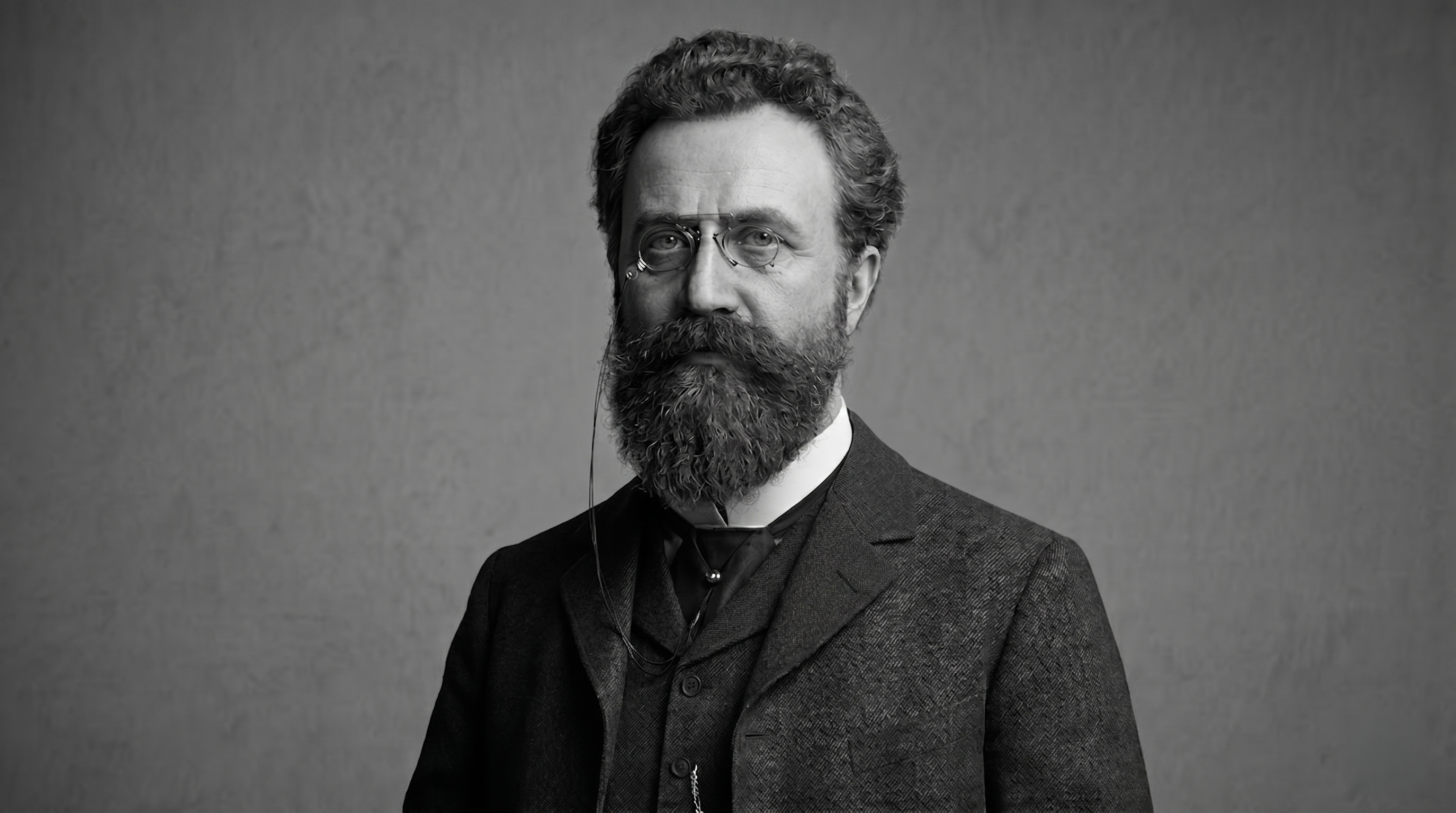
Hermann Ebbinghaus (1850–1909), whose 1885 memory experiments gave the forgetting curve its name — and gave Hermann® its own.
Show video transcript — Hermann Ebbinghaus, in his own words
Translated from the original German.
In 1885, isolated in my Berlin laboratory, I set out to scientifically measure the human memory. To understand the brain, I isolated it. I created thousands of nonsense syllables and spent years repeating them to the monotonous beat of a metronome. That is how I discovered a wonderful mathematical truth: the learning curve. When the frequency stays constant, knowledge takes root. We tame the chaos. But behind that light, I ran into a devastating biological shadow: the forgetting curve. Forgetting is not a slow trickle. It is an immediate abyss. After only 20 minutes, the brain expels 40% of what was learned. After 48 hours, the abyss has swallowed 70% of the information. Your mind is a machine built for erasure. The day after tomorrow, your most brilliant idea will be nothing more than a hazy rumor. If you entrust your truth to a single transmission, biology will turn it to ash.
The original finding
In 1885, psychologist Hermann Ebbinghaus ran a series of self-experiments memorizing lists of nonsense syllables, then tested his own recall at increasing intervals. The result was a sharp early decline: most of what he memorized was forgotten within the first day, with the rate of loss slowing down after that.
The original study used artificial, meaningless syllables specifically so that prior knowledge couldn't help recall — a useful control, but also a limitation worth naming. In 2015, researchers Jaap Murre and Joeri Dros ran a modern replication of Ebbinghaus' method and found a curve that closely matches his 130-year-old results: unreinforced information decays fast, and most of that decay happens early.
Why it doesn't fix itself with repetition alone
The intuitive fix is to just repeat the message more. But a 2006 meta-analysis by Cepeda, Pashler, Vul, Wixted and Rohrer, covering 184 studies on distributed practice, found that when information is delivered matters as much as how often. Spacing the same content out over time produces measurably better retention than delivering it in a single dense session — even when the total exposure time is the same.
Applied to a company: one all-hands, one memo, or one town hall a quarter is not a reinforcement schedule — it's a single data point on the same decay curve Ebbinghaus documented. The message fades before the next one arrives.
Why format matters, not just frequency
Spacing is one variable. Format is another. A 2021 meta-analysis by Mar, Li, Nguyen and Ta compared comprehension and recall of narrative text against expository (fact- or slide-style) text and found people consistently understand and remember information better when it's delivered as a story with people in it, rather than as a list of facts.
That is consistent with a broader pattern in how people learn from other people: observing someone else's behaviour carries more retained detail than reading a description of it. A slide deck states a value. A documentary about someone living that value in the middle of their actual work makes the same point retrievable.
What this means for your company
Reinforce on a schedule, not on occasions. A quarterly all-hands sits on the same decay curve as any single exposure — spacing the message across the year retains it better than concentrating it into one event.
Match the format to how memory actually works. Facts and slides are the weakest retained format; a story with real people in it is the strongest.
Treat this as infrastructure, not a campaign. A message reinforced once fades. A message reinforced continuously, in a format people retain, compounds — this is the mechanism Hermann® is built around.
Sources
- Murre, J.M.J. & Dros, J. (2015). Replication and Analysis of Ebbinghaus' Forgetting Curve. PLOS ONE.
- Cepeda, N.J., Pashler, H., Vul, E., Wixted, J.T. & Rohrer, D. (2006). Distributed Practice in Verbal Recall Tasks: A Review and Quantitative Synthesis. Psychological Bulletin.
- Mar, R.A., Li, J., Nguyen, A.T.P. & Ta, C.P. (2021). Memory and comprehension of narrative versus expository texts: A meta-analysis. Psychonomic Bulletin & Review.
If you are not the decision-maker,
do not schedule.